Expedited ground vs air freight: how to choose the right option for time-critical shipments
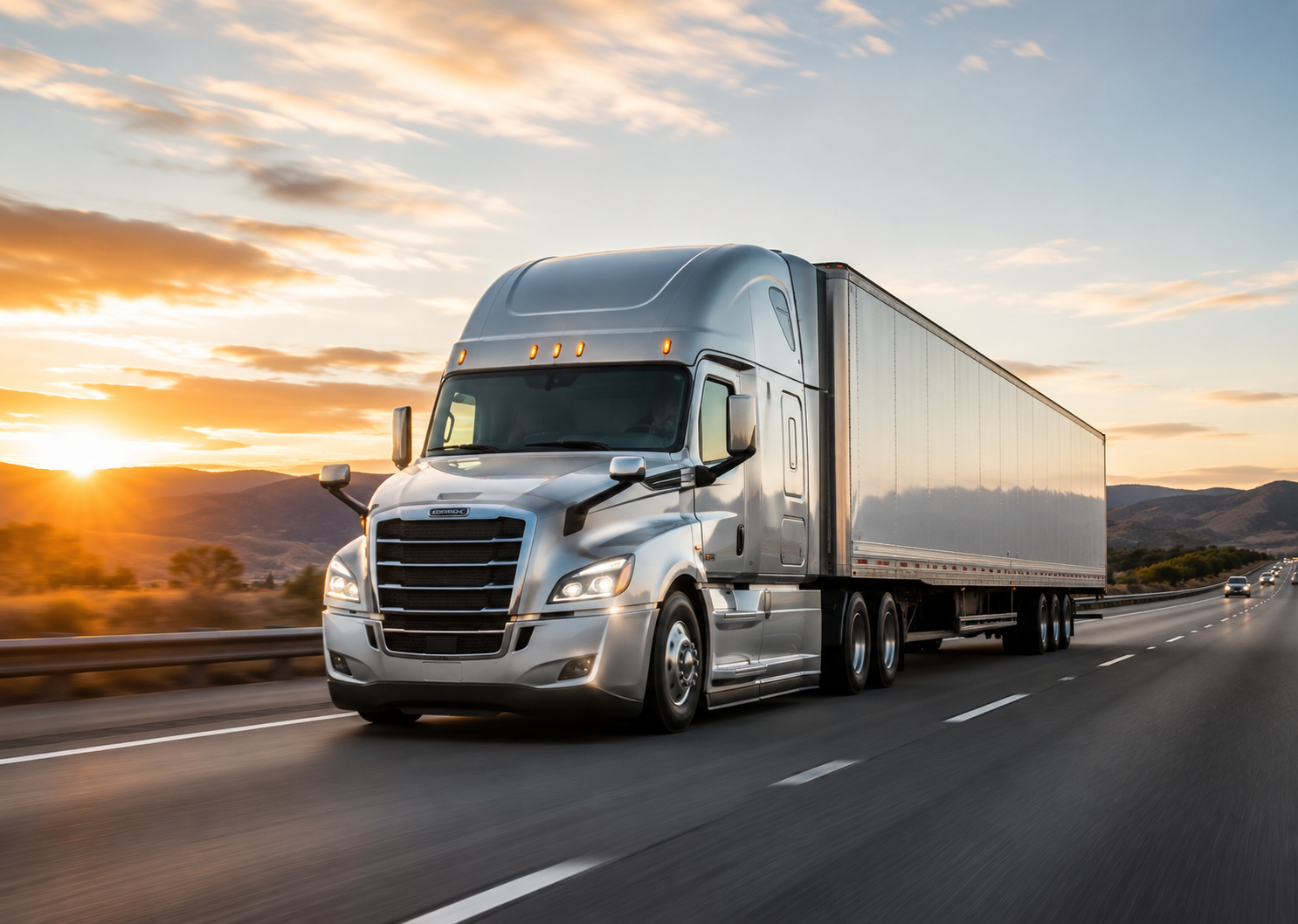
When a shipment cannot move on a standard scheduled service, you face a choice: expedited ground or air. Both options can get cargo where it needs to go faster than normal. But they are not interchangeable, and choosing the wrong one can cost you money, time, or both. The right answer depends on distance, urgency, cargo type, and what your actual deadline is — not just a general assumption that air is always faster or ground is always cheaper.
This guide breaks down how each option works, when each makes sense, and the questions to ask before committing to either.
What is expedited ground freight?
Expedited ground freight is a dedicated or team-driven truck service where your cargo moves point-to-point without the stops, terminal handling, and consolidation delays of standard LTL (less than truckload) freight. A dedicated driver — or in the case of long distances, a team of two drivers who take turns so the truck never stops — moves your cargo directly from origin to destination.
The key distinction from standard ground freight is that your shipment is not part of a consolidated load being routed through terminals. It goes directly where it needs to go, on a truck dispatched specifically for your shipment.
For distances under roughly 1,000 miles, expedited ground can match or beat air freight on total door-to-door delivery time, once you account for airport check-in windows, cargo cutoff times, customs handling, and destination pickup. For distances over 1,500 miles, air typically wins on speed unless the ground route is particularly direct.
What is expedited air freight?
Expedited air freight covers a range of services — from next flight out (NFO) on commercial passenger aircraft to dedicated air charter for larger or more time-critical loads. The common thread is that the shipment moves by air rather than road, which provides a speed advantage for longer distances where the physics of ground transport cannot compete.
Air freight introduces variables that ground does not: airport cutoff times, cargo acceptance windows, the gap between flight landing and delivery to the consignee, and weather disruptions that can cause cascading delays across a network. It is generally faster for long-distance moves, but the total door-to-door time depends on how cleanly the airport legs connect.
"The fastest option is not always the one that gets there first. Airport cutoff times, cargo handling windows, and destination pickup all add time to an air move that a direct ground service does not have."
When expedited ground is the right choice
Expedited ground outperforms or matches air in more situations than most people assume. Here are the scenarios where ground is typically the better call:
- Distances under 500-800 miles: For regional moves within a single time zone, a dedicated ground vehicle dispatched immediately can often deliver in the same window as air — without the cargo acceptance wait, airport dwell time, or destination pickup delay. Chicago to Detroit, Dallas to Houston, Los Angeles to San Francisco — these are routes where expedited ground is consistently competitive.
- Oversized or heavy cargo: Air freight has strict weight and dimensional limits. Cargo that exceeds aircraft hold dimensions, or heavy industrial parts that would require special air handling, moves far more efficiently by dedicated ground truck. A 2,000-pound machine component that is awkward for air cargo handling moves cleanly on a straight truck.
- Hazmat and restricted materials: Certain hazardous materials face tighter restrictions on air than on ground. If your cargo falls into a category that is restricted or prohibited on commercial passenger aircraft, expedited ground is often the only practical option short of a dedicated air charter.
- Same-day delivery within 600 miles: If you need delivery today and the destination is within a day's drive, a dedicated ground vehicle dispatched immediately can reach the destination in the same window as a flight, with none of the airport complexity. For overnight or next-day service within 800 miles, ground is almost always faster door-to-door than air.
- Cost sensitivity with a flexible window: When the deadline is 24-36 hours rather than 4-6 hours, expedited ground typically costs 40-70% less than equivalent air service for comparable distances. If the urgency allows ground timing, the cost saving is significant.

When expedited air freight is the right choice
Air freight earns its premium in specific situations where distance and urgency combine in a way that ground simply cannot match:
- Cross-country distances over 1,500 miles: Los Angeles to New York, Miami to Seattle, Chicago to Phoenix — at these distances the physics of ground transport cannot match air, even with a team driver. If you need it there in under 12 hours and the distance is over 1,200 miles, air is the answer.
- Deadline within 4-8 hours: Next flight out (NFO) can have cargo airborne within an hour of pickup and delivered within a few hours of landing. For the most acute emergencies — production lines down, aircraft on ground, surgical equipment needed for a scheduled procedure — nothing else matches the response time of a well-executed NFO move.
- High-value, low-weight cargo: Semiconductors, medical devices, precision instruments, and pharmaceutical cargo are typically small, light, and high-value. The air premium is a small percentage of cargo value, and the speed benefit is significant. These are natural air freight candidates regardless of distance.
- Island, remote, or international destinations: If the destination cannot be reached by ground — Hawaii, Puerto Rico, Alaska, or international — air is not a choice, it is a requirement. KLAM can coordinate both the domestic leg and the international air connection where needed.
The cost comparison in practice
As a rough guide for US domestic shipments, here is how the cost comparison typically looks for a 100-pound shipment:
- Expedited ground (500 miles): $300-600 depending on vehicle type, timing, and route
- NFO air (500 miles): $400-900 including airport couriers at both ends
- Expedited ground (1,500 miles, team driver): $1,200-2,000
- NFO air (1,500 miles): $600-1,200
At shorter distances, ground and air are close on cost. At longer distances, air becomes cost-competitive because the ground vehicle needs a team driver and more time. The crossover point — where air starts to win on both speed and cost — is roughly 1,000-1,200 miles for most cargo types.
Questions to ask before choosing
When you contact a broker for an expedited shipment, having clear answers to these questions will get you a faster, more accurate quote:
- What is the exact deadline? Not "as soon as possible" but an actual delivery window. This determines whether ground or air is viable.
- What are the origin and destination zip codes? Distance determines which mode makes sense and what the realistic transit time is.
- What is the weight and dimensions? This determines vehicle type for ground and cargo rate class for air.
- Are there any handling requirements? Temperature control, hazmat classification, fragile handling, or special equipment all affect mode selection.
- Is there flexibility on the deadline? A 6-hour window requires air. A 24-hour window opens ground as a viable and usually cheaper option.
How KLAM Expeditors handles the decision for you
When you call KLAM with a time-critical shipment, we do not default to air because it sounds faster. We look at the origin, destination, deadline, cargo type, and available options — and we recommend the mode that genuinely gets your cargo there on time at the best available cost.
If expedited ground is the right answer, we dispatch a dedicated vehicle immediately. If NFO air is the right answer, we book the next available flight and coordinate airport couriers at both ends. If the situation calls for a team driver or a combination of modes, we structure that too.
KLAM Expeditors is a licensed freight broker (MC# 1664023) operating 24/7 across the United States. To discuss a time-critical shipment, call us at +1 510 331 6699 or visit our expedited ground service page for more detail on our ground freight capabilities.