Aircraft on ground (AOG) freight: how a broker gets your plane flying again

Aircraft on ground - AOG - is one of the most expensive situations in commercial and private aviation. A grounded aircraft is not generating revenue, is occupying valuable ramp or hangar space, and is generating cascading scheduling problems for every flight downstream of it. Industry estimates put the cost of an AOG event at anywhere from a few thousand to tens of thousands of dollars per hour, depending on the aircraft and operator. The single factor that determines how quickly that cost stops accumulating is how fast the required part can be sourced, shipped, and delivered to the aircraft.
This is the exact problem AOG freight brokers exist to solve. Here is how the process actually works, and what separates a broker who can genuinely deliver in an emergency from one who cannot.
What happens during an AOG event
When an aircraft is grounded due to a mechanical issue, the maintenance team identifies the failed or required part, and procurement begins searching for the nearest available unit - which could be at a parts supplier, another airline's stock, an MRO facility, or a manufacturer's warehouse on the other side of the country. Once the part is located, the clock starts on getting it physically to the aircraft.
This is where an AOG freight broker is engaged. The broker's job is not just to book a shipment - it is to identify the fastest possible route from the part's current location to the grounded aircraft, considering flight schedules, airport cargo cutoff times, ground transport at both ends, and any customs or security clearances if the move is international.
"In an AOG situation, the part being two hours away is irrelevant if it takes six hours to get a broker on the phone, find a flight, and dispatch a courier. Response time is everything. A broker who answers immediately and moves fast beats one with marginally better routing options every time."
How AOG freight actually moves
Depending on the distance and the time pressure, an AOG shipment typically moves through one of these paths:
- Next flight out (NFO) on commercial air: For most domestic AOG situations, booking the part as cargo on the next available commercial passenger flight is the fastest practical option. A ground courier collects the part, delivers it to the departure airport, and a second courier collects it on arrival and runs it directly to the aircraft.
- Dedicated ground courier: For shorter distances - particularly within the same region or state - a dedicated ground vehicle dispatched immediately can outperform air once airport handling time is factored in.
- Charter air: For the most extreme time pressure, or when the part is oversized or there is no suitable scheduled flight, a dedicated charter aircraft may be the only option that meets the deadline. This is the highest-cost option but is sometimes the only one that works.
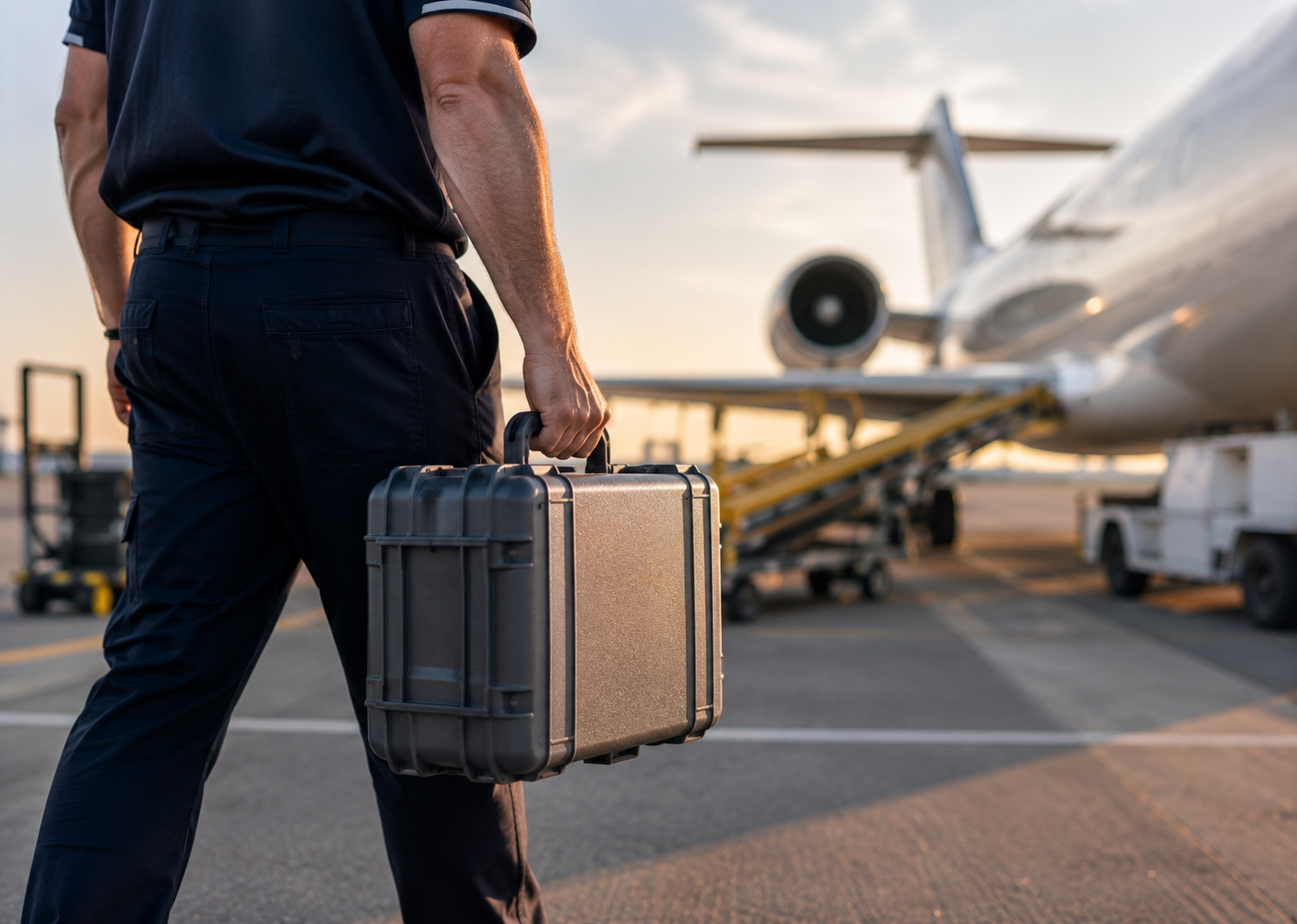
- Hand-carry courier: For smaller, high-value, or fragile components, a courier travelling as a passenger with the part as carry-on luggage can sometimes be faster and more secure than standard air cargo handling.
What to look for in an AOG freight broker
True 24/7 response, not an answering service
AOG events do not happen during business hours. A broker who routes after-hours calls to voicemail is not equipped for AOG work. Confirm you will reach a live dispatcher who can act immediately, at any hour, any day.
Speed of quote and dispatch
Time spent waiting for a quote is time the aircraft sits on the ground. A broker experienced in AOG work should be able to confirm routing and dispatch within minutes of being given the pickup and delivery details, not hours.
Airport and TSA access
Moving parts through commercial airport cargo facilities requires TSA-certified drivers who can legally access airside areas. Confirm your broker's couriers hold this certification - without it, they cannot complete the airport leg of the shipment themselves and have to subcontract, adding delay.
Experience with aviation parts handling
Aircraft components can be fragile, sensitive to handling, or require specific documentation (such as 8130-3 tags or certificates of conformance) to travel with the shipment. A broker experienced in aviation freight understands these requirements without needing to be told.
Real-time communication
During an AOG event, maintenance and operations teams need constant visibility - not a tracking number to check periodically. Your broker should be proactively updating you at each stage: part collected, en route to airport, on the flight, landed, courier dispatched, delivered.
KLAM Expeditors AOG and aviation freight
KLAM Expeditors is a licensed freight broker (MC# 1664023) with 24/7 live dispatch for AOG and other time-critical aviation freight. Our team is TSA-certified for airport cargo access and experienced with aircraft parts handling and documentation requirements. We assess each AOG situation and recommend the fastest genuinely available option - NFO air, dedicated ground, or charter - rather than defaulting to whichever service has the best margin.
For an AOG emergency, call us directly at +1 510 331 6699 for immediate dispatch. For general aerospace and time-critical freight enquiries, visit our next flight out service page or contact us to discuss your operation's specific requirements.